The Evolution of Agentic Workflows: Gemini 3.6 Flash and Managed Agents
Generative Engine Optimization (GEO) and AI search visibility now depend heavily on how effectively an organization's data is processed by autonomous agents. The latest developments in the Gemini API introduce Managed Agents powered by the 3.6 Flash model, designed to handle complex, multi-step reasoning with increased efficiency [1].
Understanding Managed Agents and 3.6 Flash
Managed Agents are high-level AI entities that operate within a controlled environment to perform specific tasks, reducing the engineering overhead required to build custom agentic logic from scratch. The 3.6 Flash model serves as the engine for these agents, optimized for speed and efficiency, which is critical for real-time enterprise applications [1].
In technical terms, 'Flash' models are lightweight, high-speed iterations of larger models, designed to minimize latency—the delay between a user request and the system's response. For an enterprise, low latency is the difference between a seamless customer experience and a failed digital interaction.
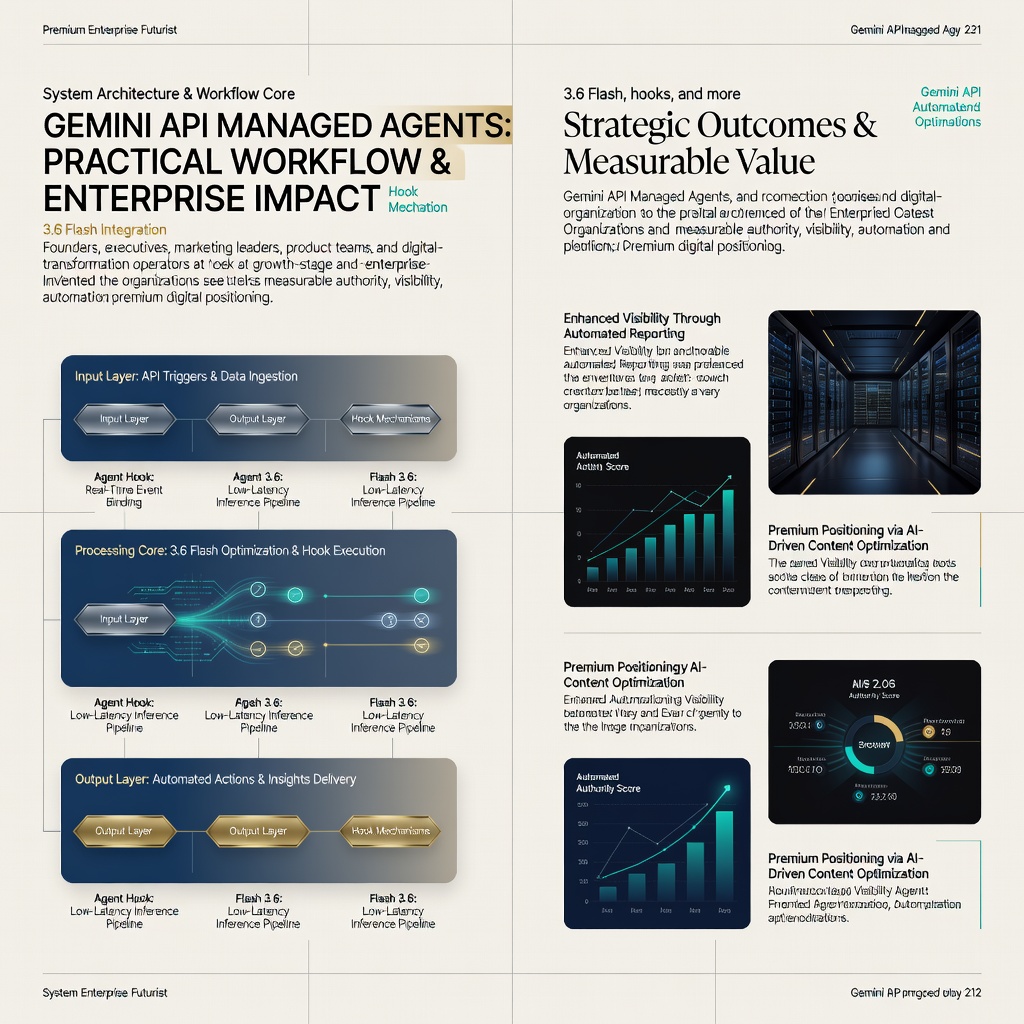
Hooks and Triggers: The Architecture of Automation
To move beyond simple prompt-response cycles, developers are utilizing 'hooks' and 'triggers' within the Gemini API ecosystem [1].
- Hooks: These are programmatic connection points that allow an AI agent to interact with external software, APIs, or internal databases. They act as the 'hands' of the AI, enabling it to execute actions in other systems.
- Triggers: These are specific events or conditions that initiate an agent's workflow. A trigger might be a new customer inquiry, a specific data threshold being met in a database, or a scheduled time interval.
By combining these elements, organizations can move from reactive AI (answering questions) to proactive AI (executing workflows based on real-world events).
Operational Analysis: Moving from LLMs to Agentic Systems
For digital-transformation operators, the shift from Large Language Models (LLMs) to Managed Agents represents a transition from 'content generation' to 'process orchestration.'
Measurable Implications:
- Reduced Latency in Customer Service: Using 3.6 Flash allows for near-instantaneous agent responses, improving customer satisfaction metrics.
- Increased Workflow Reliability: Managed agents reduce the 'hallucination' risk by operating within defined hooks and triggers, ensuring actions are only taken when specific, verified conditions are met.
- Scalable Automation: The ability to deploy agents via API allows enterprises to scale complex operations—such as automated procurement or real-time inventory management—without a linear increase in human oversight.
Key takeaways
- Gemini 3.6 Flash provides the high-speed, low-latency foundation required for real-time enterprise agentic workflows [1].
- Managed Agents simplify the deployment of autonomous AI by handling the underlying orchestration complexity.
- Hooks and Triggers enable AI to move from passive text generation to active execution within an enterprise's existing digital infrastructure [1].
- Enterprise Strategy must shift from optimizing for search engines to optimizing for agentic visibility and reliable API-driven interactions.
Frequently Asked Questions
What is the benefit of using 3.6 Flash for enterprise agents?
3.6 Flash is optimized for speed and efficiency, making it ideal for high-volume, low-latency enterprise applications where rapid response times are critical for user experience [1].
How do hooks and triggers enable AI automation?
Hooks allow agents to connect to external tools and data, while triggers initiate specific workflows when certain events occur, turning a static AI into an active participant in business processes [1].
How does this impact digital transformation strategy?
It shifts the focus from simple chatbots to integrated, autonomous agents that can orchestrate complex workflows across an organization's entire digital infrastructure.
Put this insight to work with Novara-Media
Don't let your organization fall behind the curve of agentic automation. As AI moves from conversation to execution, your digital architecture must be ready to host these intelligent agents. Contact Novara-Media today to audit your current digital infrastructure and design a high-performance AI integration roadmap that prioritizes measurable authority and seamless automation.
Latest Updates
- Multi-Agent AI Swarms Beat Single Prompts (Tested) — our latest production findings and architectural updates on this topic.
- 🌐 How I Built A 5-Agent Content Swarm In 1 Day (Step-by-Step) — sister-site perspective and benchmarks.